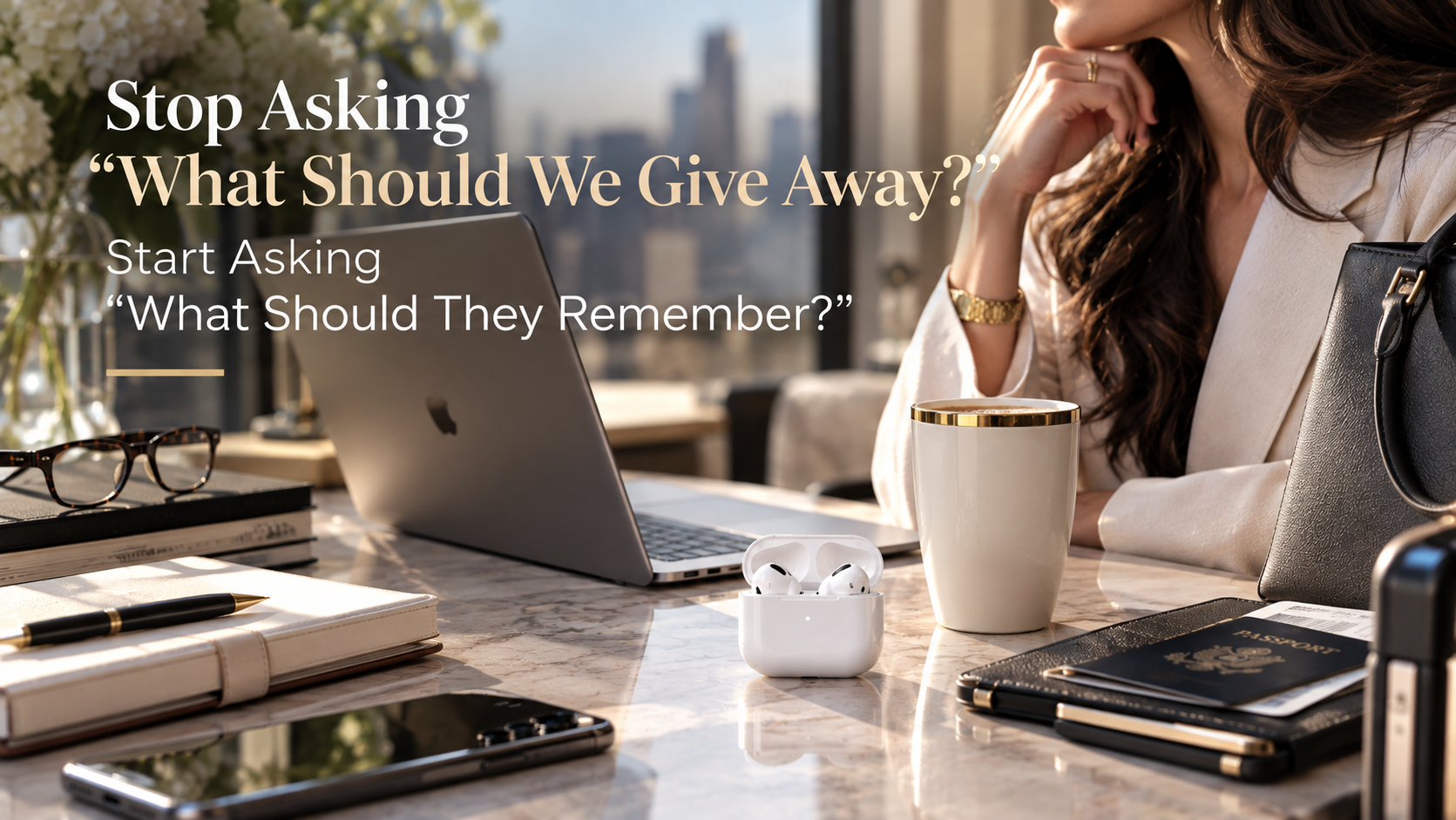
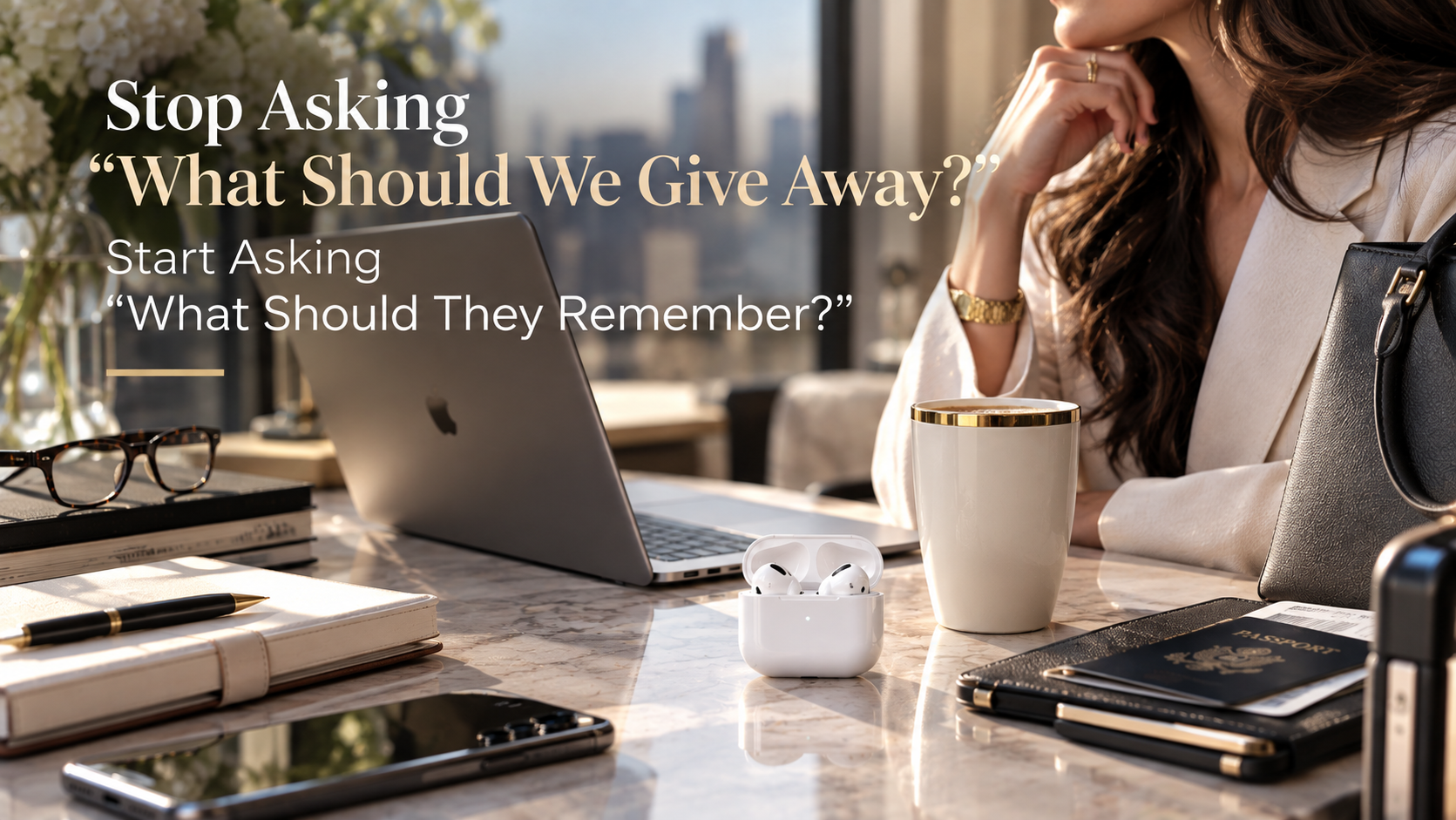
There is a familiar moment in marketing planning. An event is approaching, a budget has been approved, the logo is ready, and someone eventually asks the inevitable question: What should we give away?
It is a reasonable question, but it may not be the most important one.
Promotional products have traditionally been treated as a relatively simple extension of an event or campaign. Choose an item, add the logo, determine the quantity, and get it delivered in time. The product is often evaluated primarily on price, appearance, and whether it can accommodate the branding.
But a promotional product is doing more than carrying a logo. It is representing the company at a moment when the company isn't necessarily there to explain itself. And once the product leaves the event, the marketing team loses control of what happens next.
That is why a more useful question is not “What should we give away?” but “What should they remember?”
The difference may sound subtle, but it changes the entire way a company approaches promotional merchandise.
The Product Becomes Part of the Brand Experience
A logo identifies a company. The product surrounding that logo helps shape how the company is perceived.
A thoughtfully designed piece of technology can reinforce a company's reputation for innovation. A well-made everyday item can communicate practicality and quality. A recognizable retail brand can immediately establish a different level of familiarity and perceived value. Even something as simple as the weight, finish, functionality, or packaging of a product can influence the impression it creates.
This is particularly important because recipients rarely experience promotional products in the same context in which they received them.
A person might receive a branded power bank at a conference, but use it weeks later while traveling for work. A set of branded earbuds might leave an employee's onboarding meeting and eventually become part of their daily commute. A wireless charger may spend months sitting on someone's desk, quietly visible during meetings and workdays.
The original event may have lasted a few hours. The relationship with the product can last considerably longer.
That creates a different kind of marketing opportunity.
Memory Is Often Created Through Repetition
Most advertising asks for attention in a very specific moment. A person sees an advertisement, watches a video, visits a website, or walks past a display. Then the moment is over.
Promotional products have a different characteristic: they can return.
They can appear repeatedly in ordinary life, often without requiring another marketing interaction. A product can become associated with a morning routine, a workspace, a business trip, a presentation, or a particular activity. Over time, those repeated interactions can create familiarity with the brand in a way that a single exposure cannot.
This doesn't mean every promotional product automatically becomes memorable. In fact, the opposite can be true. If a product is poorly designed, difficult to use, or irrelevant to the recipient, the logo may be forgotten almost as quickly as the product itself.
The distinction is not simply between a branded product and an unbranded one. It is between a product that creates a reason to interact with the brand and one that does not.
That is why the selection process deserves more strategic thought.
The Most Expensive Product Isn't Necessarily the Most Memorable
There is also a temptation to assume that creating a stronger impression requires spending more money.
Not necessarily.
A product's value is determined by more than its purchase price. A relatively modest item that is used frequently may create more sustained brand exposure than a considerably more expensive product that rarely leaves a drawer.
At the same time, the lowest-cost option is not automatically the smartest choice. A product that feels disposable can communicate something about the company behind the logo. If a company wants to be perceived as innovative, premium, thoughtful, or forward-looking, the merchandise should be consistent with that positioning.
The objective, then, is not to spend the most.
It is to create the greatest connection between the product, the audience, and the message the brand wants to leave behind.
That requires marketers to think beyond the moment of distribution.
Start With the Memory You Want to Create
A better promotional strategy can begin with a surprisingly simple exercise: identify the impression you want the recipient to have after interacting with your brand.
If innovation is central to the company, technology may provide a natural way to express that idea. If practicality is important, a product that solves an everyday problem may communicate more effectively than something chosen simply because it is inexpensive. If the goal is to create a premium experience, product design, recognizable retail brands, packaging, and perceived quality may matter as much as the logo itself.
The product becomes part of the storytelling.
This is especially relevant when companies are planning larger campaigns, employee programs, conferences, customer initiatives, or seasonal marketing. Instead of starting with a catalog and asking which items fit within the budget, marketers can begin with the audience and the desired experience, then work backward toward the product.
That small change in the process can produce a much more intentional campaign.
The Question After the Event
Perhaps the most revealing test is what happens after the campaign is technically over.
The event ends. The booth comes down. The attendees go home. The presentation is finished. But where does the promotional product go?
Does it disappear into a drawer?
Does it get thrown away?
Or does it become something the recipient actually uses?
Does it travel with them? Does it sit on their desk? Does it become part of their workday? Does another person see it and ask about it? Does the recipient associate it with the company months later?
Those questions are rarely part of the initial purchasing conversation, but they are central to understanding the marketing value of the product.
Because ultimately, the goal of promotional merchandise isn't simply to put a company's name in someone's hands.
It is to give the brand a reason to stay there.
The next time a marketing team asks, “What should we give away?”, it may be worth pausing before opening the catalog.
Ask a different question first:
“What should they remember about us?”
The answer can lead to a very different product—and a much more intentional marketing strategy.